
Net Operating Working Capital Formula: Step-by-Step
Sales can rise while cash gets tighter. For a founder-led business, that often happens when more money sits in unpaid invoices or unsold inventory, while supplier bills and payroll keep coming due. Net operating working capital (NOWC) helps explain how much capital everyday operations require. The net operating working capital formula compares operating current assets with operating current liabilities, giving you a clearer view of where cash is tied up. But the number alone won’t tell the whole story. You also need to understand which accounts belong in the calculation and what changes over time may signal. Here’s how to calculate NOWC, interpret the result, and use it to plan for growth, funding needs, or a future sale.
Key Takeaways
- Measure the capital your operations require: Subtract operating current liabilities from operating current assets, using consistent account definitions.
- Look beyond the result: Review receivables, inventory, and payables to understand what is driving NOWC and whether cash may be under pressure.
- Connect working capital to growth plans: Pair NOWC with a cash-flow forecast and operating metrics before committing to hiring, inventory, or expansion.
What Is Net Operating Working Capital (NOWC)?
Net operating working capital, or NOWC, measures the short-term assets and liabilities tied to a company’s daily operations. It helps founders see how much capital the business needs to keep serving customers, managing inventory, and paying operating costs.
How NOWC Measures Operating Liquidity
NOWC offers a focused view of operating liquidity: whether operating assets can cover near-term obligations arising from normal business activity. It is not the same as cash in the bank. A positive NOWC may mean money is tied up in receivables or inventory, while a low or falling figure can point to pressure from upcoming operating bills.
Look at the components behind the number. Rising receivables might reflect sales growth, but they could also mean customers are paying more slowly. Inventory that takes longer to sell can tie up cash, too. The SoFi overview of NOWC explains how the measure focuses on liquidity connected to everyday operations.
How NOWC Differs From Net Working Capital
Net working capital, or NWC, compares all current assets with all current liabilities. NOWC focuses on the current assets and liabilities associated with operations. In common calculations, NWC includes cash and cash equivalents, while NOWC generally excludes cash, marketable securities, and interest-bearing debt. Definitions can vary, so check which items a calculation includes before comparing results.
The distinction helps answer different questions. NWC gives a broader view of short-term financial position; NOWC helps show how much capital is invested in running the business. A sizeable cash balance may support NWC, for instance, but it does not tell you whether customers pay promptly or inventory moves efficiently. Use the same classification rules each time you calculate either measure.
Why NOWC Matters to Founder-Led Businesses
For a founder-led business, NOWC can show how growth changes cash requirements. Higher sales may require more inventory or leave more money in unpaid invoices, while supplier payments may fall due before customers pay. Tracking these shifts helps you plan for working capital before a cash shortfall affects purchasing, hiring, or expansion.
Lenders and investors may also review working capital when assessing a company’s financial stability and ability to meet near-term obligations. A change in NOWC can prompt useful questions: Are collections slowing? Is stock sitting too long? Have payment terms changed? Understanding the drivers helps you explain the business’s cash needs and plan next steps. Investing.com’s guide to net working capital describes why working capital can matter in funding decisions.
What Is the NOWC Formula?
Net operating working capital (NOWC) estimates how much capital a business has tied up in its everyday operations. It focuses on short-term assets and liabilities connected to serving customers, making or sourcing products, and paying operating expenses. For a founder, it can help answer a practical question: how much funding does the business need to keep operating as sales grow?
NOWC is useful because revenue growth does not always create immediate cash. A business may need to buy inventory, pay staff, or cover other costs before customers pay their invoices. The gap between those outflows and incoming cash can put pressure on a company’s finances, even when sales are rising.
The calculation starts with operating current assets and subtracts operating current liabilities. That means the result depends on which balance sheet accounts you classify as operating. Cash and interest-bearing debt are commonly excluded to focus on the working capital required by operations, though the exact treatment can vary by analysis. Use a consistent definition, and check that your figures come from reliable financial statements. A small-business guide to working capital explains how tracking these balances can help owners identify potential cash needs.
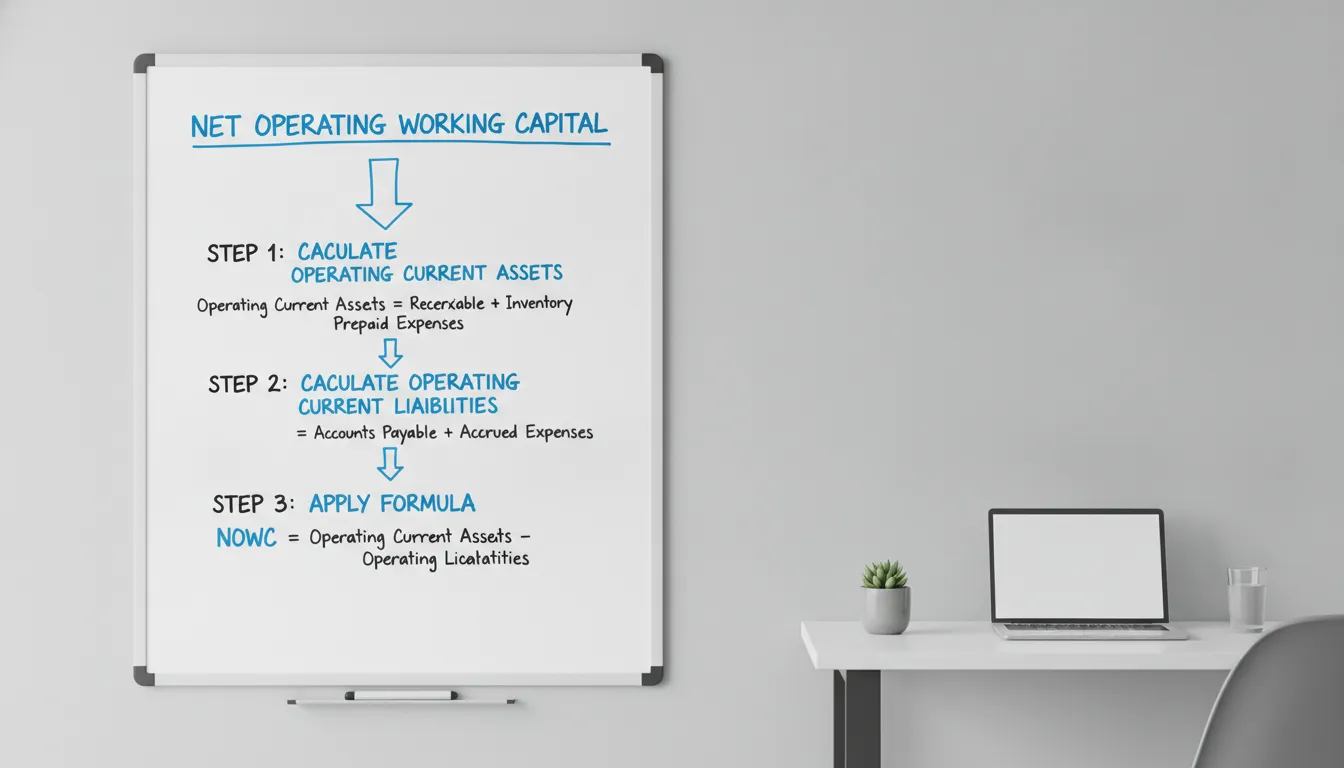
NOWC = Operating Current Assets − Operating Current Liabilities
The formula is:
NOWC = Operating Current Assets − Operating Current Liabilities
A common version is (Current Assets − Cash) − (Current Liabilities − Short-Term Debt). This removes cash and short-term interest-bearing debt, leaving operating items such as accounts receivable, inventory, accounts payable, and accrued expenses. This net working capital guide walks through the calculation.
For example, if a company has $300,000 in operating current assets and $220,000 in operating current liabilities, its NOWC is $80,000. That figure is the net amount invested in day-to-day operations, not the balance in the company’s bank account. If you are preparing NOWC for a sale, valuation, or financing discussion, confirm the calculation method with your accountant or advisor, since buyers and lenders may use their own definitions.
How NOWC Connects to Cash Flow and the Cash Conversion Cycle
NOWC helps show how operating decisions affect cash flow. If customers take longer to pay, accounts receivable can grow and tie up more cash. If inventory builds faster than it sells, more funds may sit on shelves instead of supporting other business needs. On the other hand, collecting invoices sooner or agreeing on longer payment terms with suppliers may reduce the amount of working capital required.
These patterns connect to the cash conversion cycle, which tracks how long it takes to turn spending on inventory and operations into cash collected from customers. A longer cycle can mean the business needs more cash to fund its regular activity, especially during a growth spurt. Review NOWC alongside a cash-flow forecast to see whether upcoming sales, hiring, or inventory purchases may create a funding gap. Working capital guidance for small businesses describes how changes in working capital can signal potential cash shortages or available funds.
Apply Consistent Classification Rules Across Periods
NOWC comparisons only tell a clear story when you use the same classification rules each time. Decide which accounts count as operating assets and liabilities, then apply those rules across monthly, quarterly, and annual reports. For example, if you include accrued payroll as an operating liability in one month, include it in subsequent periods as well.
A change in classification can make NOWC appear to move even when the business itself has not changed. If your chart of accounts or accounting practices change, document the adjustment and, where possible, recalculate prior periods using the new method. Before drawing conclusions, also check that the underlying balances are accurate and recorded in the right period. A step-by-step working capital calculation guide highlights the importance of reliable information when measuring working capital.
Which Items Belong in the NOWC Formula?
NOWC includes short-term assets and liabilities tied to day-to-day operations. To calculate it, separate those balances from cash, investments, and financing items. The exact treatment of some accounts can vary, so use a clear definition and apply it consistently. This makes NOWC easier to track and explain to a lender, investor, or potential buyer.
Include Operating Assets: Accounts Receivable, Inventory, and Prepaid Expenses
Include current assets the business uses to make sales and deliver products or services. Accounts receivable is money customers owe for completed sales. Inventory includes products held for sale, as well as materials and work in progress needed to fulfill orders. Prepaid expenses, such as insurance or rent paid in advance, belong in NOWC when they support near-term operations.
These balances show where cash is tied up. Rising receivables may point to slower customer payments, while growing inventory could reflect slower sales or planned stock ahead of a busy season. SoFi’s NOWC overview identifies receivables, inventory, and prepaid expenses as common operating current assets. Review account details to confirm they relate to normal business activity.
Include Operating Liabilities: Accounts Payable, Accrued Expenses, and Deferred Revenue
Include current liabilities that arise from ordinary business operations. Accounts payable covers unpaid supplier invoices. Accrued expenses are costs the business has incurred but has not yet paid, such as wages, commissions, or utilities. Deferred revenue is payment received for goods or services the business still needs to provide.
These balances can help fund day-to-day activity, but they remain obligations. For example, a subscription business may collect annual fees upfront and record deferred revenue until it delivers the service. SoFi’s NOWC guide lists accounts payable, accrued expenses, and deferred revenue as common operating current liabilities. Include each balance only once, and check that it reflects normal operations.
Exclude Cash, Marketable Securities, and Interest-Bearing Debt
Cash and cash equivalents are generally excluded because they are funding resources, not operating assets like receivables or inventory. Marketable securities are usually excluded as well, since they are investments rather than assets required to deliver products or services. Leaving these balances out helps focus NOWC on the cash tied up in core operations.
Exclude interest-bearing debt, including short-term borrowings and the current portion of loans. These items reflect financing choices, not operating obligations such as supplier invoices. A business may need to keep a minimum amount of cash available for routine expenses, but treatment varies. Decide whether that minimum belongs in your analysis, document the choice, and apply it consistently when comparing periods.
Classify Taxes, Lease Liabilities, and Minimum Operating Cash Consistently
Some accounts call for judgment. Payroll and sales taxes payable may arise from regular operations, while income taxes are often treated separately. Lease liabilities may also be presented apart from ordinary operating payables, particularly in a valuation or sale process. Because definitions can differ, don’t assume every business or analysis should treat these balances the same way.
Start with the purpose of your calculation, then set a consistent rule for each account. Financial Edge Training’s explanation of operating working capital focuses on the short-term assets and liabilities required to run operations. Use that principle to assess ambiguous items, record any exceptions, and check with your accountant or advisor if you’re preparing NOWC for a lender, buyer, or valuation.
How Do You Calculate and Interpret NOWC?
Net operating working capital (NOWC) shows how much capital your core operations require. Calculate it by subtracting operating current liabilities from operating current assets. Include items such as accounts receivable, inventory, accounts payable, and accrued expenses. Exclude cash and interest-bearing debt so the result focuses on resources tied up in running the business.
Use the same classification rules each time you calculate NOWC. For example, if you include accrued expenses in operating liabilities this quarter, include them in future calculations, too. Consistent definitions make it easier to compare results and identify what’s changing.
NOWC is a snapshot, not a complete picture of financial health. A positive result doesn’t guarantee cash is available to pay bills on time, particularly if much of the value sits in overdue invoices or slow-moving inventory. A negative result may be normal for businesses that collect payment upfront, but it can also point to pressure on cash. Review the number alongside a cash-flow forecast and operating metrics to understand what is driving it.
For a founder-led business, this analysis can make growth plans more practical. Hiring, larger inventory orders, and new customer contracts can all change how much cash operations need. Tracking NOWC helps you spot those needs early and decide whether to adjust timing, spending, or funding plans.
Calculate NOWC Step by Step With Hypothetical Figures
Imagine your business has $180,000 in accounts receivable, $120,000 in inventory, and $20,000 in prepaid expenses. Together, these operating current assets total $320,000. It also has $90,000 in accounts payable, $30,000 in accrued expenses, and $10,000 in deferred revenue. These operating current liabilities total $130,000.
Subtract operating current liabilities from operating current assets: $320,000 minus $130,000 equals $190,000 in NOWC. In this example, $190,000 is tied up in the operating cycle. Cash and short-term borrowing aren’t included. If you’re unsure how to treat an account, define your approach and apply it consistently. Banc of California’s guide outlines how to separate operating items from cash and short-term debt.
Interpret Positive, Negative, or Changing NOWC
Positive NOWC means operating current assets exceed operating current liabilities. It may indicate that the business has a cushion for near-term operating needs, but the composition matters. A large accounts receivable balance, for example, won’t help cover payroll if customers pay late.
Negative NOWC means operating current liabilities exceed operating current assets. That can work for businesses that collect from customers before paying suppliers, but a sudden decline may signal growing cash pressure. As Trovata explains, working capital needs depend on the timing of cash coming in and going out. Look beyond the sign of the result: compare it with past figures and identify which accounts changed.
Compare Results Across Periods, Industry Norms, and Seasonal Patterns
Compare NOWC across months, quarters, or years to see whether more capital is becoming tied up in operations. A rising figure may reflect growing receivables or inventory. A falling figure could point to faster collections, leaner stock levels, or changed supplier terms. Check the underlying accounts to understand the cause.
Seasonal patterns can change the result. A retailer may carry more inventory before a busy period, while a service firm may have higher receivables after completing a large project. Compare similar periods, such as this quarter with the same quarter last year, and use industry benchmarks as context rather than fixed targets. Monitoring these changes can help identify potential cash shortages or excess reserves, as Revenue D’s working capital guide explains.
Manage Collections, Inventory, Supplier Terms, and Growth-Related Cash Needs
If NOWC is rising, review where cash is getting held up. Follow up on overdue invoices, make payment terms clear, and consider whether your billing process can move faster. Check inventory levels against sales plans, too. Stock that sits unsold ties up cash that could support other needs.
Supplier terms also affect NOWC. Discuss payment schedules with suppliers before changing how or when you pay. Late payments can strain relationships and disrupt supply. Before hiring, opening a location, or placing a large order, estimate how the decision will affect receivables, inventory, and payables. Slow inventory turnover and delayed customer payments are common working capital challenges, according to Revenue D’s guidance. Build these cash requirements into your growth plan.
Track NOWC Alongside Cash-Flow Forecasts and Operating Metrics
Review NOWC alongside a cash-flow forecast. The forecast estimates when cash will enter and leave the business; NOWC helps explain how much capital day-to-day operations require. Together, they can show whether a planned investment or sales increase may create a short-term funding gap.
Add operating metrics such as days sales outstanding, inventory turnover, and days payable outstanding. These can help you pinpoint whether a change comes from slower collections, excess stock, or supplier payment timing. Excluding cash and short-term debt keeps the focus on core operating efficiency, as Banc of California’s NOWC guidance notes. Set a regular review cadence and investigate meaningful changes early, while you still have time to adjust purchasing, spending, or collection practices.
Frequently Asked Questions
How often should I calculate NOWC?\ Monthly is a practical starting point for many small businesses. If sales, inventory, or cash needs shift quickly, review it more often. Compare similar periods and check the accounts behind any notable change.
Can NOWC be positive while my business is short on cash?\ Yes. NOWC may include invoices customers have not paid and inventory that has not sold. Review collection timing, stock levels, and your cash-flow forecast to see whether funds will be available when bills come due.
Is negative NOWC always a problem?\ No. A business that collects customer payments before paying suppliers may operate with negative NOWC. A sudden change, however, can signal that operating bills are outpacing incoming cash. Look at the reasons for the change and how it affects upcoming payments.
What is the difference between NOWC and net working capital?\ Net working capital generally compares all current assets with all current liabilities. NOWC narrows the view to assets and liabilities tied to operations, usually excluding cash and interest-bearing debt. Definitions can vary, so confirm which accounts are included before comparing figures.
What should I prepare before sharing NOWC with a lender or potential buyer?\ Gather current financial statements, document how you classified each account, and use the same method across periods. Ask your accountant or advisor to review unusual items, such as lease liabilities or taxes, since a lender or buyer may use a different calculation.